

Miscellaneous
Interview with Helmut Hampl (Head Coach of TTC OE Clarity Telefonie-Systeme Bad Homburg)
For Helmut Hampl, an intense and successful career on the sidelines of the table tennis court came to an end at TTC OE Bad Homburg in the Table Tennis Bundesliga (TTBL) at the conclusion of the regular season, following several decades in the sport. In this interview, the 73-year-old talks about developments in table tennis in general, the differences between his coaching posts, and also about his “golden touch” in working with stars like Timo Boll or Jörg Roßkopf when they were very young.
Helmut Hampl, it’s been a few days since your last game as head coach of a TTBL team. Do you feel like you’ve already settled into retirement?
What does retirement mean? Let me put it this way: I won’t be standing in the hall every day anymore—that’s roughly what it will look like. I’m turning 74; mentally, everything’s fine, but physically, after two or three sessions, you start to realize that you’ve reached your limits.
What emotions did you feel at the end of the season, or even earlier during the last home game?
The last home game was really emotional. Everyone surprised me. I actually didn’t want that and told the club so. But then my son got involved, and because an absolutely incredible number of players from all those years showed up, it was amazing and very moving—especially when my two granddaughters, wearing jerseys, took my hand as I walked into the arena. That was a lovely surprise and made me very happy.
Your relationship with Timo Boll is considered a special one. What did his visit to your last home game mean to you?
I’ve stayed in touch with Timo all these years. Whenever he has time, he always comes.
How do you plan to use this extra bit of free time in the future?
I’m sure I’ll find something to do. My granddaughters will surely need their grandpa more often soon, my garden looks very neglected and isn’t in good shape anymore—so there’s plenty of work to do. But I’ll also continue to do some work in the youth program two or three days a week. My little granddaughter always says, “Grandpa, when I’m six, I’m going to the hall with you”….
You’re handing over your team and your position to Slobodan Grujic. Why did you choose your former player?
It would be a shame if everything I’ve built up over the past two years just fizzled out. That’s why we all felt it was important to have someone take over who thinks about table tennis the way I do. Slobodan Grujic fits the bill in many ways. “Bobo” played for me for 15 or 16 years; I trained him as a coach. We’ve celebrated major successes together, like the Champions League and the Cup. He also approaches table tennis in a way that’s similar to how I see it. We’re a good fit and get along well. He wants to continue developing, and I really think Bad Homburg is the right stepping stone for him—even though he already won the championship with Saarbrücken in 2020.
That sounds good too: a championship-winning coach for Bad Homburg...
Yes, but you also have to see the differences: In Saarbrücken, almost all the players were already fully developed, but our players still need to reach that level.
You’re stepping back from the front lines and will serve as sports director going forward. What will your responsibilities be?
There will probably be three of us on the sports board. I’ll mainly handle organizational matters, the team, and similar issues, and possibly also individual development.
Let’s broaden our perspective a bit. How did your work in Bad Homburg differ from your previous Bundesliga stints at TTV Gönnern and TG Hanau?
In Gönnern, we had a regular training group, and since there weren’t that many tournaments back then, people would always be there for a solid two to three weeks of training, so we could work with the players much more frequently and intensively. It was similar in Hanau, but that’s when the other commitments started to come into play. And these days, it’s just the way it is—in addition to preparing for the Bundesliga, you also have to factor in the other tournament dates. Back then, you had one to two weeks to prepare for a wide variety of conditions; today—if you’re lucky—you only have three days. In Gönnern, with Timo Boll, we kept working even after the season was over. Nowadays, the players leave after the last league match and don’t come back until the end of July.
What were the personal highlights for you during your time in the top division?
There were plenty of highlights in Gönnern, such as the two Champions League victories. It was different in Hanau, partly because the concept was different—after taking over Gönnern’s license, there was no established youth system to build on. In Bad Homburg, it’s completely different with twelve teams; the people there are incredibly passionate and crazy about table tennis, and right now, everything is falling into place.
The TTBL is currently wrapping up its 60th season. For decades, you were among the league’s long-time companions and defining figures. How would you describe its development?
Over the years, the league has become much more professional, and that has to be the goal. In most venues, the playing conditions are really great. On top of that, there’s the media coverage with live broadcasts that people in Asia and the rest of the world can watch if they want to. That’s great; that’s professional.
How do you deal with often being presented primarily as the discoverer and promoter of stars like Jörg Roßkopf, Timo Boll, or Franziska? Or does that even bother you?
Why should that bother me?
Because it might make your entire work seem reduced to that…
Timo, “Rossi,” Patrick Franziska, and many, many other players emerged from the system I built in Hesse through age-group championships, tournaments, and talent scouting—they simply stood out. That made it easy to integrate such young players into the Bundesliga at the right time. And when you work with players from the ages of eight or nine until they’re 18, 19, 20—or in Timo’s case, even 27—you can certainly call yourself a discoverer and promoter.
In your opinion, what is the secret to your success—or your “magic touch”—when working with young players?
For me, every child and every player is unique. No two players are alike; comparisons are really impossible. Once the basic techniques are in place, the individual techniques and training must be tailored to each player.
Going back to your departure: Is it really over for you as a coach as of Sunday, or does the saying “Never say never” apply to you as well?
I will no longer hold a position within the association. There are various tasks at the club where I can help and provide support, including the club’s strong junior team. Of course, I will be there to support and advise the new head coach.
Thank you very much for the interview, Helmut Hampl.
Florian Manzke
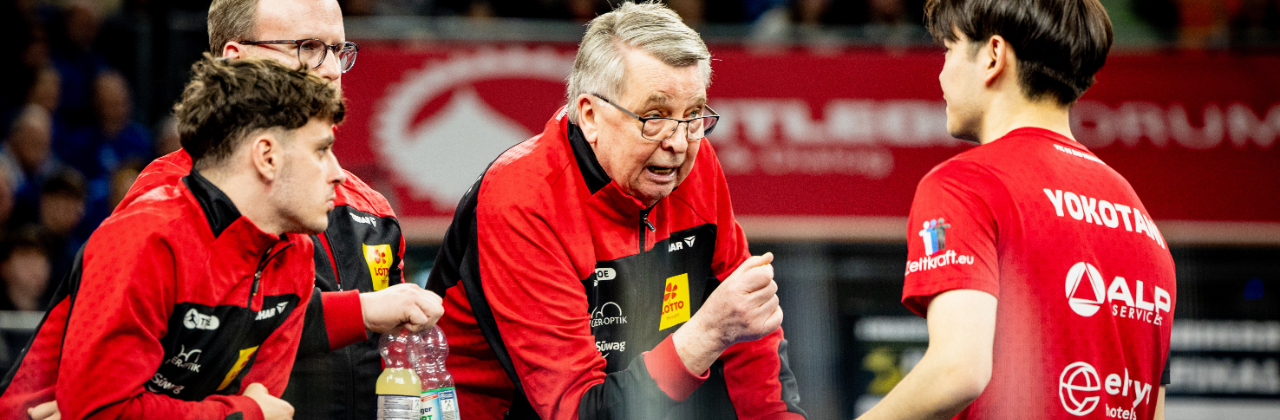
Featured image above: Helmut Hampl and the Bad Homburg team at the 2026 Cup Final4 (Photo: BeLaSportfoto)